Welcome to the Website of the Society for the History of Alchemy and Chemistry (SHAC), publisher of the scholarly journal Ambix.
Founded in 1935, SHAC has consistently maintained the highest standards of scholarship in all aspects of the history of alchemy and chemistry from early times to the present. The Society has a wide international membership from over thirty countries.
We hold meetings and webinars, offer scholarly prizes and grants, and publish the journal Ambix. The Society’s newsletter, Chemical Intelligence, is published twice a year. We have also established the Graduate Network to bring together postgraduate students in the field.
Keep up to date with the news and events of SHAC by following us on Facebook and Twitter.
You can watch our SHAC Online Seminars on YouTube here.
Please note that changes are processed manually and you will receive a confirmation email when our records have been updated. For any queries please find relevant contact information on https://www.ambix.org/contact-us/
Next SHAC on-line seminar, Thursday, 22 January 2026, 5pm (London Time)
The next on-line seminar of the Society for the History of Alchemy and Chemistry will be given by Dr Michael Bycroft (University of Warwick) who will present:
Gems and the Crafts in the Chemical Revolution
This will be live on Thursday, 22 January 2026, beginning at 5.00pm (London time). The format will be a talk of 20-30 minutes, followed by a moderated discussion of half an hour.
The seminar will be also accessible live on YouTube at: rtmp://a.rtmp.youtube.com/live2 When booking please ensure that you provide the e-mail address where you would like your link to be sent. Both links will go live just before the seminar.
Gems and the Crafts in the Chemical Revolution Michael Bycroft Chemistry is inseparable from the chemical crafts. This is a commonplace in the historiography of chemistry. But what about the relationship between the crafts themselves? How were chemical ideas shaped by the interaction between different arts, trades and industries? I answer this question with respect to gemstones in European chemistry in the latter part of the eighteenth century. In this period, and not before, chemists found general procedures for dividing gems into their component substances. Miners, apothecaries, glass-makers, and porcelain-makers were all involved in this process, as well as jewellers and diamond-cutters. These interactions between crafts were not just a matter of generalization or juxtaposition. New kinds of analysis emerged when two or more crafts interacted. Chemistry was greater than the sum of its crafts.
‘Michel Serres, historian of science despite himself’
Bernadette Bensaude-Vincent, Emeritus Professor, Université Paris 1 Panthéon-Sorbonne
9 April 17:00
Maison Française d’Oxford
Abstract:
In 1969 Michel Serres was elected professor in the history of science at University Paris 1 Panthéon-Sorbonne where he served until 1989. However, this mathematician turned philosopher considered this election as a mistake or even a mischief and he never endorsed the role of historian. He taught the history of science in spite of himself although he was an expert in this domain, unlike Sganarelle, the Doctor in spite of himself staged by Molière. For him, teaching the history of science was a way to reconcile his two passions for science and literature.
In this paper I will outline three aspects of Serres’s unorthodox view of the history of science: i) there is no rigid boundary between science, fable and myths; ii) science generates a time of its own that is neither amenable to the arrow of progress nor to a timeline; iii) his history science raises a philosophical question: who are the subjects of knowledge?
SHAC Spring meeting “Remembering Bill Brock: Chemistry and Culture“
10 April 2026
Arranged with and at the Maison Française d’Oxford, 2-10 Norham Road, Oxford, OX2 6SE
This meeting is being held to commemorate the life, work and legacy of William Hodgson Brock (1936-2025), who spent his entire career at the University of Leicester. Sometime chair of SHAC and editor of its journal Ambix, Brock was one of the leading historians of chemistry in his time, writing the Fontana/Norton History of Chemistry, as well as biographies of William Crookes, Justus von Liebig and Henry Edward Armstrong. (An extended obituary can be found at https://www.tandfonline.com/doi/full/10.1080/00026980.2025.2489298). The papers to be presented at this meeting take their starting point from Brock’s work and historical interests.
9.30
Registration and Coffee
9.55
Welcome:
Stéphane Van Damme, MFO, and Frank James, SHAC
10.00
First Brock Award Lecture:
Bernadette Bensaude-Vincent, Université Paris 1-Panthéon-Sorbonne The history of chemistry through the lens of materials. A very short introduction
10.45
Session 1:
Alan Rocke, Case Western Reserve University: The Best of Frenemies: Liebig and Dumas (A Tribute to William H. Brock)
11.15
Coffee
11.45
Session 2:
Eira H. Betthell (Booth), University of Essex: From Laboratory to Library: Bill Brock’s Prolific Writing as Chemical Practice Matthew Daniel Eddy, Durham University: A Context for Colonial Chemistry: Thinking with Bill Brock about the Biomedical Relevance of Dr J. A. B. Horton’s Experiments on the Soil of Sierra Leone Georgiana D. Hedesan, University of Oxford: The Foundation of the Society for the Study of Alchemy and Early Chemistry in 1935: Between Historical Research and the Transmutational Paradigm Michael Jewess, Independent Scholar: Working with Bill: Robert Fergus Hunter (1904-1963)
13.15
Lunch
Not provided but there are some good pubs nearby
14.30
Tribute from the Brock family:
Susannah Ahluwalia, Gareth Brock and Benjamin Brock
14.50
Session 3:
Julia Carr-Trebelhorn, University of Cincinnati: Burning Diamonds: Lavoisier, Guettard, and the 1771 Development of Reduction Firing and Hard-Paste Porcelain in Paris John R.R. Christie, University of Oxford: Commerce, Manufacture and Practical Chemistry in 18th– Century Britain Robert Bud, Science Museum/UCL: Poison gas and Art Deco: analysing early 20th century ambivalence about chemistry
16.00
Coffee
16.20
Session 4:
Robin Mackie, Open University and Gerrylynn K Roberts, Independent Scholar: Counting the British Chemical Community, 1881-1971: Opening the ‘Black Box’ Annette Lykknes, Norwegian University of Science and Technology: Crookes’ Vis Generatrix in teaching and learning
17.15
Closing remarks
17.20
End of meeting
There is no charge for this meeting, but please let Frank James, frank.james@ucl.ac.uk, know if you wish to attend.
The next on-line seminar of the Society for the History of Alchemy and Chemistry will be given by Dr Stefania Buosi-Moncunill (University of Barcelona) who will present:
From Sacred Plants to Golden Wine: The Alchemist’s Art of Healing
This will be live on Thursday, 27 November 2025, beginning at 5.00pm (London time). The format will be a talk of 20-30 minutes, followed by a moderated discussion of half an hour.
As with recent seminars the Zoom link can be freely accessed by anyone, member of SHAC or not, by booking through the following Ticket Source link:
From Sacred Plants to Golden Wine: The Alchemist’s Art of Healing
Stefania Buosi-Moncunill
This presentation explores the many healing dimensions of medical alchemy as it was practiced within the Occitan-Catalan school of the Middle Ages and early Renaissance. It is based on extensive archival and philological research and forms part of the forthcoming collected volume The Medical Legacy of Medieval Alchemy: Elixirs, Healing Waters, and Precious Stones (Palgrave, 2025), co-edited with Lawrence M. Principe (Johns Hopkins University).
At the heart of the Occitan-Catalan medico-alchemical tradition lies the idea of a medicina integralis, a holistic vision in which the healing of the body and the regeneration of the spirit converge in a single quest for harmony with the cosmos. Remedies such as theriac, aurum potabile, and the elixir were not mere pharmacological compounds, but true thresholds of transformation leading toward deeper states of balance and knowledge.
William ‘Bill’ Hodson Brock (1936-2025) was one of the leading historians of chemistry of the last fifty years. As Chair of SHAC and editor of Ambix he played a major role in the Society from the 1960s to the 2000s. He also wrote on the history of publishing, education and many other aspects of nineteenth-century science and culture, publishing in 1992 The Fontana/Norton History of Chemistry, a general history of chemistry from antiquity to the present.
To commemorate his life, work and legacy, SHAC is organising a one-day meeting to be held on Friday 10 April 2026 at the Maison Française d’Oxford.
Offers of papers (including a short abstract) related in some way to Brock’s work should be sent to Frank James (frank.james[at]ucl.ac.uk) by 30 November 2025.
The first Brock Award is given to Bernadette Bensaude-Vincent for her lifetime of outstanding work in the history of chemistry. For about four decades she has produced original and thought-provoking research in the history and philosophy of chemical and materials science, significantly shaping the historiography of chemistry. Her work stands as an inspiring example of how innovative approaches in these fields can not only illuminate significant historical and philosophical ideas in the chemical sciences, they can also meaningfully contribute to addressing contemporary societal challenges. Bensaude-Vincent has played a key role in establishing collaboration and building scholarly communities across Europe, and in nurturing new generations of scholars in history of chemistry, both formally and informally.
The Brock Award honours Professor William ‘Bill’ Hodson Brock (1936-2025), one of the leading historians of chemistry of the last fifty years, and is for outstanding contributions in the fields of the history of alchemy and chemistry.
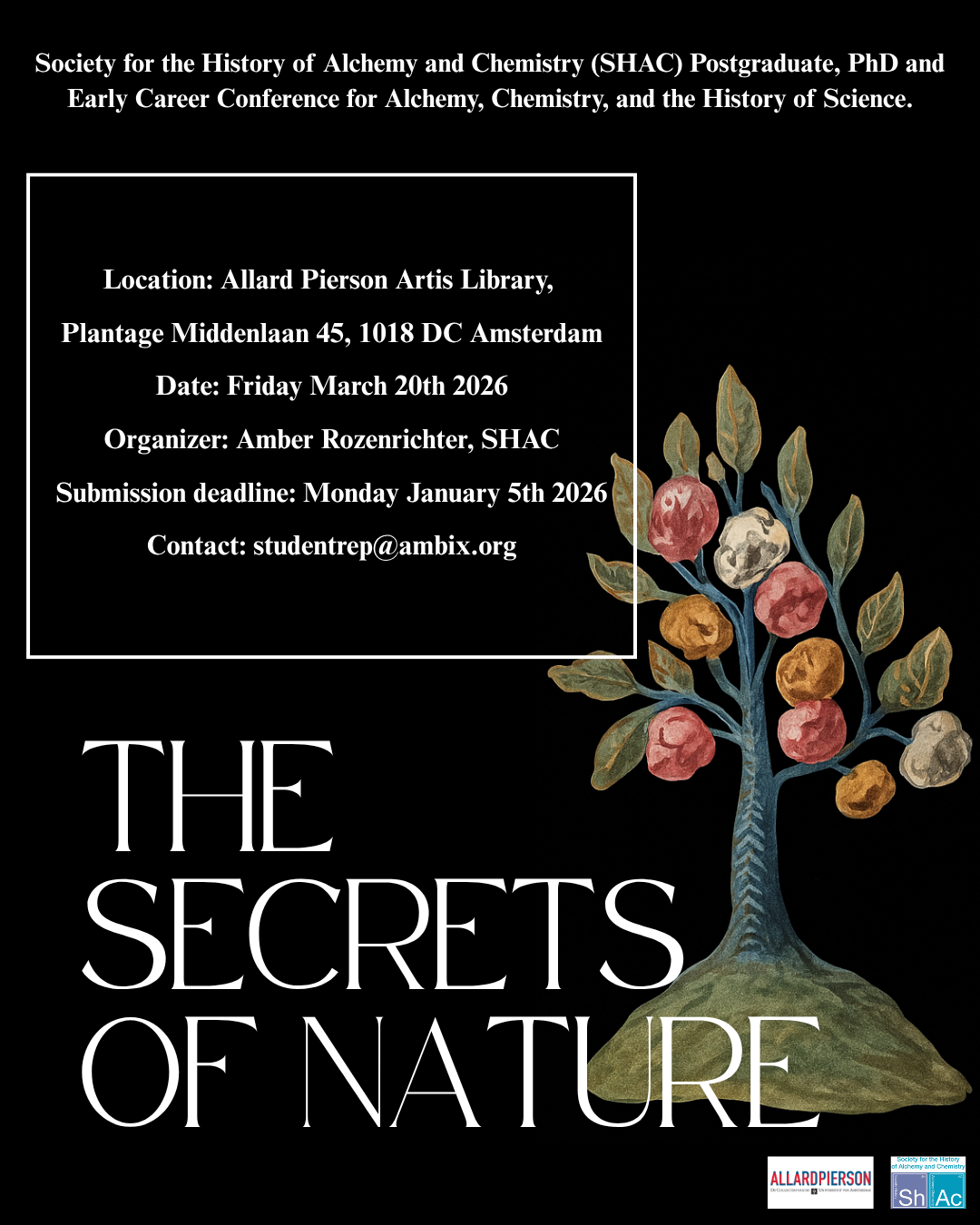
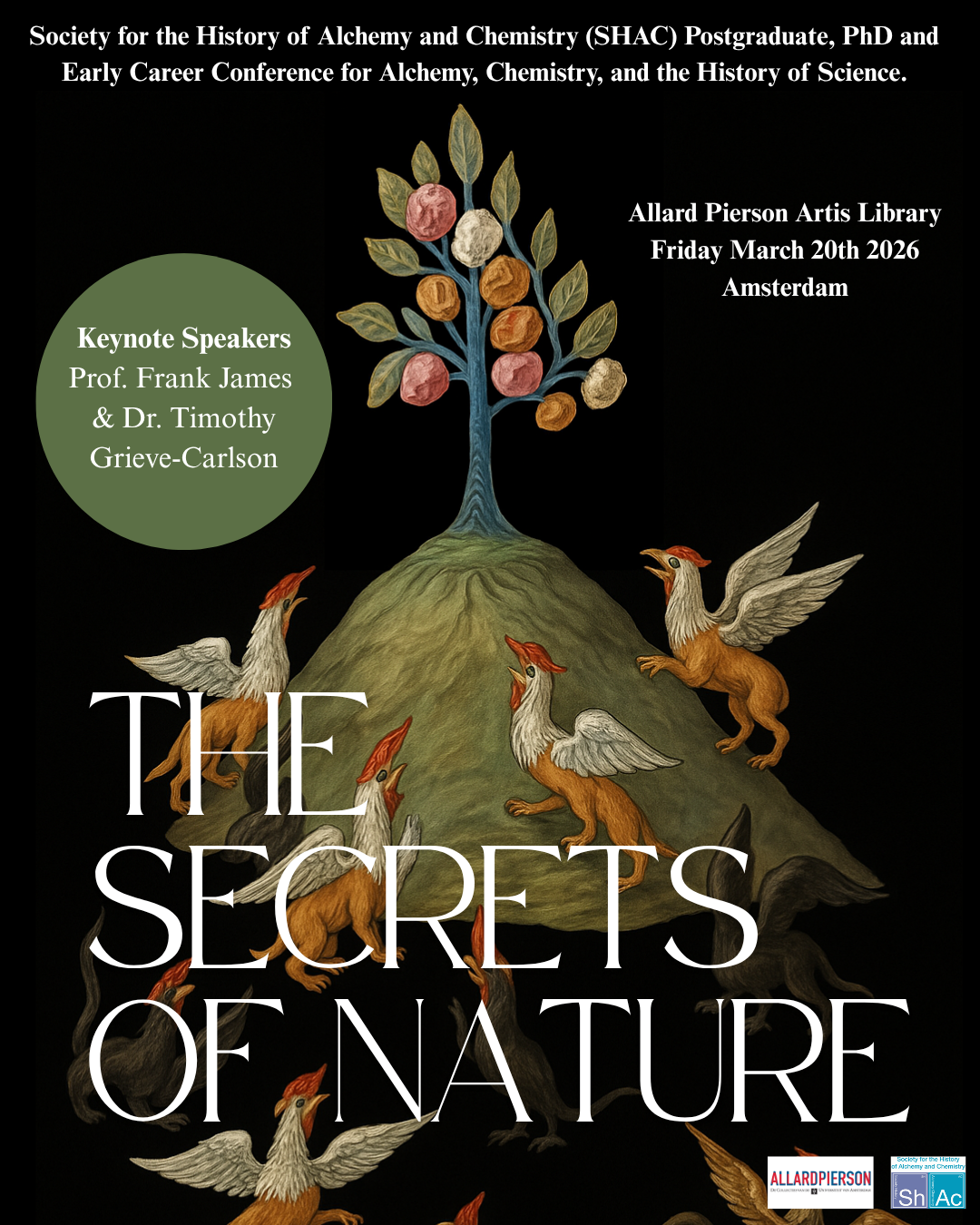
Friday 20 March 2026 at the Allard Pierson Artis Library, Plantage Middenlaan 45, 1018 DC Amsterdam.
Deadline for submissions: January 5th 2026
This conference seeks to explore the relation between (al)chemical work and “The Secrets of Nature” within and beyond the laboratory. By foregrounding this theme, this conference emphasizes the central role of nature in Alchemy and Chemistry, disciplines that have been fundamental to the History of Science and to Intellectual History more broadly.
This conference invites participants to consider how the theme of Nature has been explored, represented, and debated across different contexts and periods. This topic allows for a wide range of approaches, from textual and visual analysis to conceptual and methodological reflections. The aim of this conference is to create an academic setting in which early career researchers can come together, share their work, and open new conversations about the place of the natural world in the history of alchemy and chemistry. We are delighted to announce that Prof. Dr. Frank James and Dr. Timothy Grieve-Carlson will deliver the keynote lectures at this event, which will be hosted in the Allard Pierson Artis Library, located in Amsterdam’s historic Plantage district. Surrounded by 19th-century architecture and botanical gardens, Artis has long been a center for the study and display of the natural world, playing a key role in the development of the History of Science in Amsterdam. Participants will also have the opportunity and are encouraged to engage with the rich collection of the State-owned part Bibliotheca Philosophica Hermetica of the Allard Pierson; the manuscripts and printed books from the collection are available for consultation, offering researchers the chance to work directly with sources. Access the collection online using the links provided below. https://www.allardpierson.nl/en/natural-historyhttps://www.allardpierson.nl/en/collection/history-of-sciencehttps://www.allardpierson.nl/en/esotericism
Suggested topics include, but are not limited to:
● Conceptions of nature in alchemy, chemistry, and natural philosophy.
● (Al)chemical emblems and other visual strategies to transmit (al)chemical knowledge.
● (Al)chemical practice and the development of Early Modern medical knowledge in botanical gardens, for example the case of the Hortus Medicus in Amsterdam.
● Environmental history and historical understandings of the natural world.
● The transformation of substances: chemical processes and their conceptual frameworks.
We welcome proposals for 20 minute talks by graduate students, postdoctoral researchers, and early career scholars who have received their doctorate no more than three years ago. If you are interested in presenting your work, please send an abstract of approximately 300 words and a short bio to SHAC Student Representative Amber Rozenrichter at studentrep@ambix.org. The deadline for submissions is 5th January 2026.
If you have any questions please contact Amber Rozenrichter at the above email address.